If your organization has been tracking state privacy legislation as a “watch and monitor” item, that posture is overdue for a change. Twenty states now have comprehensive consumer privacy laws in effect. Three more — Connecticut, Arkansas, and Utah — have significant updates or new provisions taking effect July 1, 2026. That’s thirty days from now.
State attorneys general are no longer warming up. They are enforcing. The era of grace periods and informal compliance expectations is over. What follows is a practical rundown of where the landscape sits, what’s coming next month, and what your compliance program needs to do about it.
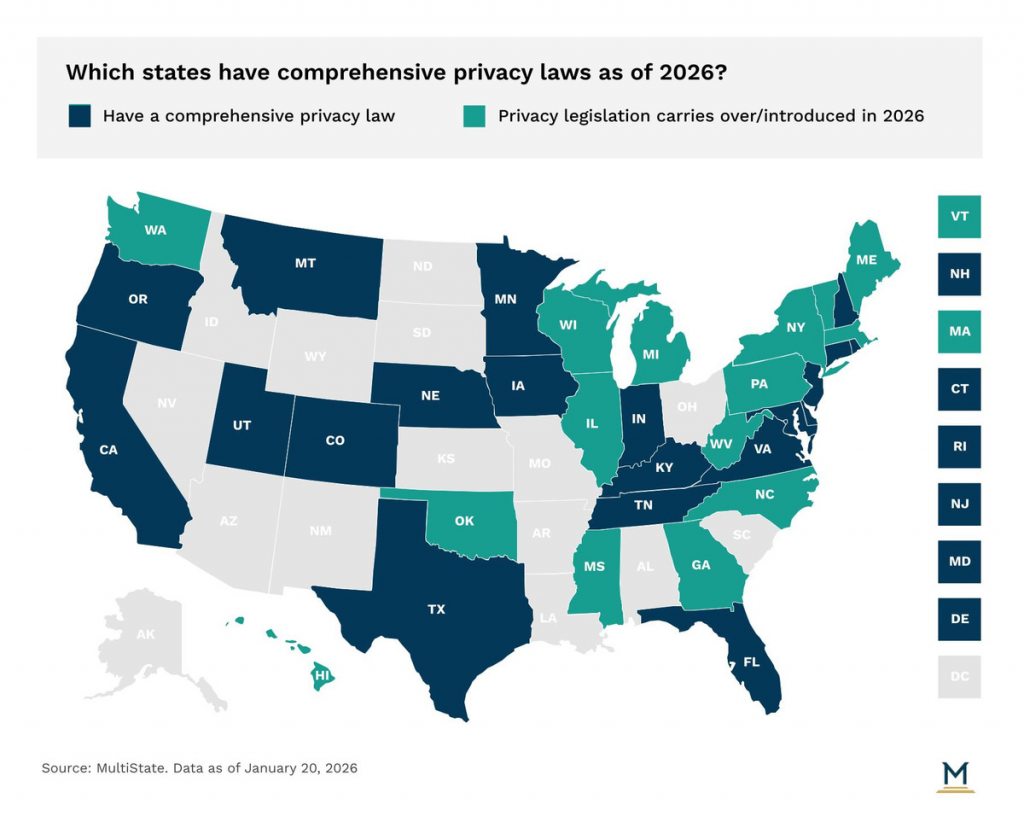
What’s Already in Effect
Twenty states now have comprehensive privacy laws in effect, with Indiana, Kentucky, and Rhode Island joining the landscape on January 1, 2026. All three largely mirror the Virginia Consumer Data Protection Act template, establishing consumer rights around access, correction, deletion, and opt-out of targeted advertising and data sales. RSA
California’s Consumer Privacy Act regulations for automated decision-making technology, risk assessments, and cybersecurity audits also became applicable at the start of the year. If your organization makes automated decisions affecting California residents — credit decisions, hiring screening, content recommendations, insurance pricing — you now have active obligations around transparency, opt-out rights, and documented risk assessments for those systems. These aren’t future requirements. They’re current ones. Security Insight
In 2025 alone, reported fines and penalties against US-based companies under state privacy laws reached an estimated $1.4 billion. The enforcement signal is clear. National Cybersecurity Alliance
What Hits July 1
Connecticut’s amendments are the most substantive of the July 1 changes. The updates add expanded sensitive data definitions and enhanced protections for minors under 16. The cure period under Connecticut’s law — already limited — is narrowing, and the AG’s office has signaled it will not treat technical opt-out failures as good-faith compliance gaps. National Cybersecurity Alliance
Connecticut’s enforcement posture is worth paying attention to specifically because they’ve already acted. The Connecticut AG settled its first action under the CTDPA for $85,000 in 2025, with violations centered on a privacy notice described as “largely unreadable,” absent consumer rights disclosures, and inoperable opt-out mechanisms. Critically, the AG had previously issued a deficiency notice that the company failed to adequately address — a pattern regulators will use to demonstrate willfulness and justify higher penalties in future matters. National Cybersecurity Alliance
That settlement is a template for what regulators will pursue and how they’ll characterize organizational failures. An unreadable privacy notice isn’t a minor formatting issue. It’s a documented violation with a dollar figure attached.
The Core Compliance Problem
The absence of a federal privacy law makes inter-state coordination more significant, not less. Businesses cannot rely on federal preemption to simplify their compliance obligations. They must manage the patchwork directly. National Cybersecurity Alliance
That patchwork is genuinely complex. The threshold for covered entity status varies by state. Definitions of sensitive data differ. Opt-out mechanisms don’t work the same way everywhere. Data protection impact assessment requirements — when they’re required, what they must cover, how they’re documented — aren’t standardized.
By 2026, 20 states have active comprehensive data privacy laws, creating significant compliance challenges for businesses operating across multiple jurisdictions. For organizations without dedicated privacy counsel or a structured privacy program, the practical question is where to start. Enterprisemanagement
Where to Focus Right Now
Map your data flows against state thresholds. Coverage under each state law depends on how many residents’ data you process and, in some cases, what percentage of your revenue comes from data sales. Before you can assess compliance, you need to know which laws apply. Start with the states where you have the most consumer exposure and work outward.
Audit your privacy notice. Connecticut’s enforcement action is a warning. If your privacy notice is long, unclear, or missing required disclosures — consumer rights, contact mechanisms, data categories collected, purposes for processing — it’s a liability. Readable, accurate, and current are the baseline.
Verify your opt-out mechanisms work. Broken or ineffective opt-out links are one of the most common enforcement triggers. Test them. Test them across devices. If your privacy team isn’t running periodic opt-out mechanism audits, add it to the calendar.
Build your DPIA process for California. California requires data protection impact assessments for processing activities that present a heightened risk of harm to consumers, including targeted advertising, profiling, and processing of sensitive personal data. If you have California exposure and no DPIA process, that gap needs to close before an AG inquiry forces the conversation. Cisco
Prepare for July 1. If Connecticut, Arkansas, or Utah are on your coverage map, audit your compliance posture against their updated requirements now. A month is enough time to address gaps if you start today. It’s not enough time if you start on June 30.
The state privacy landscape is no longer a horizon event. It’s the current operating environment. Organizations treating it as a future compliance project are accumulating exposure every quarter they wait.
Discussion Questions
- Has your organization completed a covered entity determination across all 20 active state privacy laws? Are you confident in which laws currently apply to your operations?
- When did you last audit your privacy notice for accuracy, readability, and required disclosures? Has it been updated to reflect current data practices and new state requirements?
- Do you have a documented DPIA process for high-risk processing activities? If California is on your coverage map, is that process operational?
Further Reading
- IAPP US State Privacy Legislation Tracker: https://iapp.org/resources/article/us-state-privacy-legislation-tracker/
- California CPPA Automated Decision-Making Regulations: https://cppa.ca.gov/regulations/
- Connecticut AG Privacy Enforcement Guidance: https://portal.ct.gov/AG/Sections/Privacy/The-Privacy-Enforcement-Division
- NIST Privacy Framework: https://www.nist.gov/privacy-framework
Leave a Reply